Wednesday, 23 July 2014

Everything wrong with society can be explained by coffee (alt: Why Nespresso is carried by the the first of the four horsemen)


This is absolutely the wrong place to order coffee


Everything that is wrong with society can be explained by coffee.

I was thinking about repeating that line, but I guess most of you would have read the title so it should no longer be necessary. If you have not read the title, you may find familiarity between the way you live your life and the problems associated with the existence of instant coffee (if there are more ingredients in your coffee than 'coffee', you desperately need to re-evaluate your priorities) which I'll write about another time.

As I'm in love with the sound of my own voice (and I talk a lot of garbage) I've frequently explained to people who have stood still in my proximity for slightly too long my problem with attractive baristas. Basically it goes like this: if I enter a cafe, and an attractive, somewhat bubbly late-teen barista smiles at me, I'm immediately disappointed and lower my expectations. I might even be so moved as to order a can of Coke, or a cup of tea instead, as no-one can stuff that up.

Burn the leaves? Yeah, I don't believe you.

On the other hand, if I wander in and am greeted (or better yet, ignored) by a grumpy, balding Italian, someone who looks malnourished, anyone with dreadlocks, or better yet, facial tattoos, then I might order two. It's not a difficult concept to grasp. The Italian was trained to work an espresso machine before he was on solid food, anyone with dreadlocks was obviously hired for their skills and not their merits of socially acceptable presentation or pleasant smelling hair, and obviously a man who has facial tattoos (somehow girls get away with the 'behind the ear thing' quite easily) and can still get a job in customer service must have a pretty convincing skill resume. So that's a win, and I prepare for delicious caffeinated deliciousness.

So if you missed that, here it is: If you're both attractive and a barista, I automatically assume you don't know what you're doing. I'll still probably order from you, because I'm not all that discriminatory, but I am definitely judging you.

But let's skip back. I've wandered into a cafe, made my order, received a milky/lukewarm/burnt to hell/lemon bitter mess that doesn't deserve to be served in the same cup as coffee, and as I sip politely, my eyes boring holes into the hipster-approved unpainted brick walls, the evaluation process begins. Have I brought this on myself? Should I have known better? Have I mistakenly ordered coffee from a burger joint, or somewhere that has deals on jugs of Carlton on Thursday nights? Does it specialise in seafood? Is it in fact a particularly trendy fish and chipper? Has McDonalds really upped the decor game at McCafe? Did O-week students cover up the Gloria Jeans sign as a prank? Or have I forgotten that I still live in Asia?

Once I've passed the checklist of self-accusation, I start to get a little annoyed. Perhaps offended. There's two reasons for this.

Firstly, someone has bought, paid for, built up, worked at, and in general sacrificed irreplaceable time in making a business which makes a rubbish product. You have the room, the chairs, the food, the fridges, probably even a chef, surely it's not that much of a larger step to purchase some decent bean and make sure your staff don't have thumbs where they should have fingers.

Secondly... ever heard the saying 'that man is depriving a village somewhere of an idiot'?

I'm not in fact suggesting this man/lady/ladyguy is an idiot. But I am suggesting they are not a barista. So either they've fallen into the trap of apathy, or they are depriving society of a plumber, accountant, or sandwich artist. If a plumber installed gutters that leak, or the Subway guy put the ham outside the bread, you'd rubbish him. And so you should. You entered a contract with that man when you agreed to pay him for his work, and if I said no pickles, then I expect no pickles, and they're gherkins anyway so change your sign 'cos this isn't America.

Basically, a barista who is bad at making coffee is holding our global society back. There, I said it.

I should clarify. I can't use an espresso machine. I could probably fix one, or at least turn it on. I'm pretty good like that. But I don't know how to use one. It's not my job. There are people who have devoted their lives to coffee, and I'm happy to fund their lifestyle buy purchasing my lattes from them. Sometimes I fix their cars.

Anyway. I promised explain everything in relation to coffee, and I'm probably incapable of that, so I'm just going to throw in an analogy that links life and coffee instead. Pay attention, you might learn something.

Imagine your new job, girlfriend, car, sporting club, or circle of friends in the form of an espresso shot. The first half of the shot is called a ristretto. It's sweeter than an espresso, and contains less caffeine.
This is the first week of the relationship. The honeymoon period at a new workplace. The test drive, twice round the block.
But if you run the water through the bean a little longer, say, 8-10 seconds instead of 4-5 (and I'm sure someone can correct me on that exact number) your ristretto becomes an espresso. The taste changes, and the bulk of the caffeine is delivered. The levels of acidity (that is, the bitterness) become more apparent and you get a truer sense of what the bean is capable of delivering.
This is the hard-earned win, besting the opposition when the cards were stacked against you. The completion of a road trip, your overloaded wagon having never missed a beat. The apologetic embrace that follows the relationship's first tiff.

If we just drank ristrettos, our coffee would be sweeter. But acidity isn't necessarily bitter, and sweetness isn't always energy.

If we judge life on our first glance, our first feeling, we risk losing out on the full, rich experience. The sweetness can be appreciated, but understand what it is: a first glance, and nothing more. Don't devote your life to chasing the sweet, or the new. And don't be so quick to compare The New to The Familiar. It's this new, sweet feeling that has ended marriages, turned friends away, made relationships sour, and caused unnecessary debt on new vehicle purchases.

So drink the full shot of life, and find all it has to offer you.


Next time I'm gonna talk about milk. Or Nespresso. Seriously, there is no need for all those stupid little cups...


Monday, 26 May 2014

Fade to Grey

I often find myself staring out into yonder. People watching.
I see people going about their daily lives, living out the daily grind.
Funny how that means something different to everyone.
I see a man watching the traffic go by, and I wonder what he's thinking.
A poor man, guiding in a rich man's car. Waiting for the menial sum to be pushed out the window afterwards. Why is that? What caused his world to be that way?

It's easy to excuse the poor as a simple people, with simple thoughts, and not the lofty ideals notions that we possess. When we see a plot of land, we see a house or a development: an investment for the future, or another piece of the puzzle that is our life's goals.
A poor man sees a plot of land... What does he see? What does he think? Does his simple life dictate that he holds simple views? Does he possess the capacity to be financially successful? Is he limited by his resources, or are his resources limited by his mindset? Or is he a victim of circumstance: a rich, influential, intelligent man, trapped in the body of a peasant?

Depending on which scale you measured by, my wife and I are either moderately well off or obscenely rich. Monetary stature aside, one area of true richness we hold is in the friendships we've made.

Over a beer or three, a friend and I talked about life.

My friend is a well educated man. Now by that I don't necessarily mean he's a Rhode Scholar. He is academically clever enough: but the wisdom I refer to is drawn from years lived abroad, in different countries and cultures, working with people to find solutions to whatever problems they may face. He has formed what many lack, and what is almost impossible to teach in a lecture hall. He has what I would refer to as a balanced world view, something many professors, lecturers, and leaders of nations have failed to grasp - and yet which is something that is required to prevent prejudice, judgement, and racism within yourself.

On this fine afternoon, we saw fit to cover the big issues. One of which was the issues of bar girls.

'Bar girls' is an innocent enough term in Australia. When applied to Thailand, however, it takes on a different angle.

You see, a bar girl starts the night serving beer, and talking to the patrons. It's very common for people to go to a bar by themselves- think of travelling businessmen, for example. There's nothing sadder than a man sitting in a bar by himself, drowning his sorrows. Someone to talk to is nice. So the girls will sit by him, across the bar, hanging on his every word. He opens up, because... well. His wife/friends/parents/boss doesn't understand him anyway, and buys her a drink, and buys many more for himself and for her. And her wage is justified again.

Now, during the course of the night, should someone take a particular fancy to that bargirl, her full attention can be purchased from the bar for the remainder of the evening. This purchase is referred to as the barfine. Following the payment, a second, personal payment will be negotiated with the bar girl as to the end result of the night's activities.

If you have an inkling that what I'm referring to is prostitution, then you're pretty much on the money. But if you're thinking this girl is a prostitute, then you're only half right.

My friend works in different countries throughout south east asia. To his credit, he's gone to the effort of learning the language of at least one of the countries that he has lived in. So he's in a bar, having a beer, and quite bored. So he begins chatting to one of the bar girls. He's talking in her native language, which is making things a lot easier on her behalf.

The direction of the conversation soon turns to what brought her to be working in a girly bar in Phuket.

I'm from the country, she explains, and I send money home to my family. I can make money here I could never make back at home.

So, what of the mechanics of this whole thing? Do you have much say in who you go home with at the end of the night?

She explains that she's not planning on working here for long. She'd like to meet someone one day, maybe marry a guy who once came to the bar. Other girls she knows have done it, and are living a good life. And besides, it's not like she'd go home with just anyone. She wouldn't go home with a jerk, just the nice guys. She'd never leave with someone she doesn't feel safe with.
Kinda, if you think about it... the sort of guy she'd like to stay with.

All of this got me thinking.

We live in a polished, western world. Even those of us who have left the western world still see everything through our own western lenses. Culture, whether it be ours or theirs, never goes away, and never stops influencing how we view a given situation.

"You grow up your whole life with people telling you that things are black or white," he says.

This girl's a bargirl.
This girl's a slut.
This one's a whore.
This one... well, she's just looking for a man.

"But it doesn't work."

Life, he says, is grey. You can't make a judgement on something by what you see on the outside.

In that moment he spoke of more wisdom that I've read in any textbook, heard from a pulpit, or spat from my own mouth.

You don't know, because you don't know her.

Or him. Or them. Or anything.

Maybe. Just maybe.

If we looked at life as though it were grey, maybe we wouldn't see bargirls. Or whores. Or bums, peasants, beggars, queers, slags, or druggos.

We'd see people.

But all we see is problems.

Food culture.

I should really take photos before I stir it all up 
Roast pork wan tan mee, from the food hall near the office blocks. Chicken rice, with chili and lime sambal, from pretty much anywhere. Penang char kuey tau, preferably from Penang, but the place in Lucky Garden does a pretty good one too.
Tai bu mee. Pudu noodle, as my wife calls it. House-made wan tan noodles, soup with shrimp wan tans, sliced roast pork and minced pork gravy stuff on top, generous application of pickled jalepenoes, usually washed down with one of the (terrible!) sweet kopi ais – iced coffee. They use a cloth bag full of ground bean set in a pot of boiling water. Then they mix it with sweetened condensed milk. Because diabetes is for life, and not just for Christmas.
Anyway. I'm eating there one day, and there's a bloke sitting next to me in a business shirt and tie. The weather is stiflingly hot, and the hole-in-the-shed-wall of a place we're eating this delicious feast of the gods has neither AC nor fans, but here he is, patiently waiting on his bowl of steaming goodness while Jem and I shovel ours down our throats as fast as physics allow while letting slip occasional moans of gratefulness and indescribable satisfaction. Anyway, shirt guy is looking at me with a curious angle on one eyebrow. I stop wolfing for a moment and smile at him.
“How'd you hear about this place?” he says.
“Luck,” I reply, “we found it when we were looking for the market.”
He does the eyebrow thing again and leans back from the table a bit.
“This is the most authentic tai bu mee in the city,” he says.
“I walked a long way to have lunch here. My father used to eat here, and HIS father used to eat here too.”
Roast duck. Oh, sweet duck. What did you do that God would make you so delicious? Is there a verse missing in Genisis 3? Did I miss that in Sunday school?
“Cursed are you, oh duck,” saith the Lord, “For your sins, ye shall fly across the lands, seeking safety from the pit of Man's bellies. But your deliciousness shall know no bounds, and neither shall thine fleeing...”
I almost feel bad. To hell with steak, I could eat duck for the rest of my life and die happy. Morbidly obese, but if that's the cost of happiness, then put me down for five, please.
The other day I was on Zuckerburg's method of global productivity theft and I saw a post from a Malaysian I know who lives back home.
It's normal here, like everywhere else I presume, for some people to post pictures of their dinners before eating it. Now it may only be in Malaysia that people go to the extent bringing the SLR and five different lenses out to document their order, but Instagramming your food is pretty standard.
Ol' mate back home was pre-gramming, though. He was posting pictures of the food he was going to eat tomorrow. There's some excitement levels without parallel on display here. It was food I recognised, too, roast pork, and ducks hanging up on hooks in the glass windows of the little food carts that you see anywhere in Asia.
But the following day, no lunch-o-gram was to be found. The shop had sold out, you see. I can only presume every Asian in Geelong has cleared them out before he arrived.
So I did the only thing an Australian male could do, and sent him pictures of my lunch – roast pork rice, with fresh sambal on the side. And then I took some photos around the shop.
Big trays of beef rendang. Curried mutton. Brianni rice. Piles of uncooked wan tan mee. I thought I had him on the ropes.
I was wrong.
“Are you sure you want to come home, Joshua?”
The roast pork turned to ash in my mouth. The smell of duck made me sad. The fish heads peered up from the baymaree, YOU'LL MISS US WHEN WE'RE GONE they mouthed, in a silent, dead fish kinda way.
Game. Set. Match. The slender Malaysian man in the corner, tapping on his phone between consultations.

Well. I used to be sure.
It's been said you can never judge another's culture without bias, because you can never un-learn the culture of yourself. But everyone tries, and you make discernment on what you see all the same.
I don't get why being thirty minutes late to work is ok, but it's frowned upon to arrive on time, but leave at six.
I don't get why people slow down to take photos of accidents on the roadside.
I don't get why 'yes' means yes, no, I don't know, I'll check, we don't have that, I can't, and maybe.
And I don't get why in spite of crazy working hours, everyone takes their full hour at lunch time. But I kinda wish I did.
I'm not really employed at the moment, but for a while I was working underneath perhaps one of the most successful PR men in SEA. An older Australian man, who claims five divorces as the only reason for him to keep working as his age. He walks by his secretary's desk and pauses. Looks at her, and smiles.
He turns to me.
“You know,” he starts, “one of the things I've learned over the years, is that it doesn't matter what is happening, or how busy you might be. Whatever crazy situation you find yourself in, everything will always stop for makan.(eating)”
His secretary smiles.
“Of course,” she says, swallowing her noodles, “lunchtime is sacred.”

I don't get a lot of things I see here in Malaysia.
I parked my junk of a scooter outside an upper-class plaza in KL. Between a Harley bagger and a shiny Kawasaki. The guard approached me, and told me I couldn't do that. I pointed at the other bikes, but he kept saying no until I took of my full-face and he saw I was white.
“Malay, cannot,” he says, “Indian, Chinese cannot, but you sir, can.”
I hate that his job is to discriminate.
But then, I've never seen a homeless man turned away from a mammak. He goes to the owner, who points him to a chair, and serves him. I've tried to pay for his meals in this situation before – always, always the owner has refused.
Food is a right. Feeding is a responsibility, carried out by the lowest earning restaurateurs in the city.

I don't know why we don't see things the same way.

But I really wish I did.  

Tuesday, 22 October 2013

Car trouble. Myanmar. Toe surgery. Fail.


The Magnificent Volvo has suffered a minor setback. The alarm system has gone kaput.
On the one hand, that's bad, because broken things inevitably cost money. And on the other hand, it doesn't really matter. Who ever wired up the system failed to include any sort of immobiliser in it. So while the alarm sounds, you can still put the keys in the ignition and drive the car away.
I did exactly that, and the guard at our house didn't even look up from the morning paper. I'd hoped a short drive would enact some kind of override, and the alarm would stop. It didn't.
So I (literally) ripped the alarm out and we continued, still with the hazard lights flashing away, and that's how it's stayed for the past two weeks.
I don't want to spend more money on that stupid thing. It cost $1000+AU at the last service, and it didn't even grow wings and fly after that.
So if you need a giggle, think of Jem, driving the twenty five minutes to work every day with the hazard lights on.
Which, being Malaysia, doesn't even raise an eyebrow with the police.

Ah, the beauty of Myanmar, caught mid-sneeze

Myanmar was interesting, for most of the time. It has incredibly lovely, helpful, genuine people, and
about 20 bazillion temples. If you like temples, and would like to hate them, go to Myanmar. Temples (or Pagodas, for that matter) now make me feel nauseated.

Things to do:
Walk around:
Meet people. See them smoking cigars, carrying huge baskets on their heads, smiling, being helpful, and sneaking out in pairs to go sit up at the temples with their boyfriends/girlfriends. Funny stuff.
Ask someone about An Sung Soo Chi:
She's the national hero. For a long time I wondered why the government hadn't killed her off; she caused them a fair bit of grief over the years. Now I know; the whole country would have revolted against them.
Buy some Ann Sung Soo Chi merchandise:
I bought a coffee mug. Jem was given a keyring, with the head of Ann rising out of the centre of a rose. Classy, and understated.
Eat:
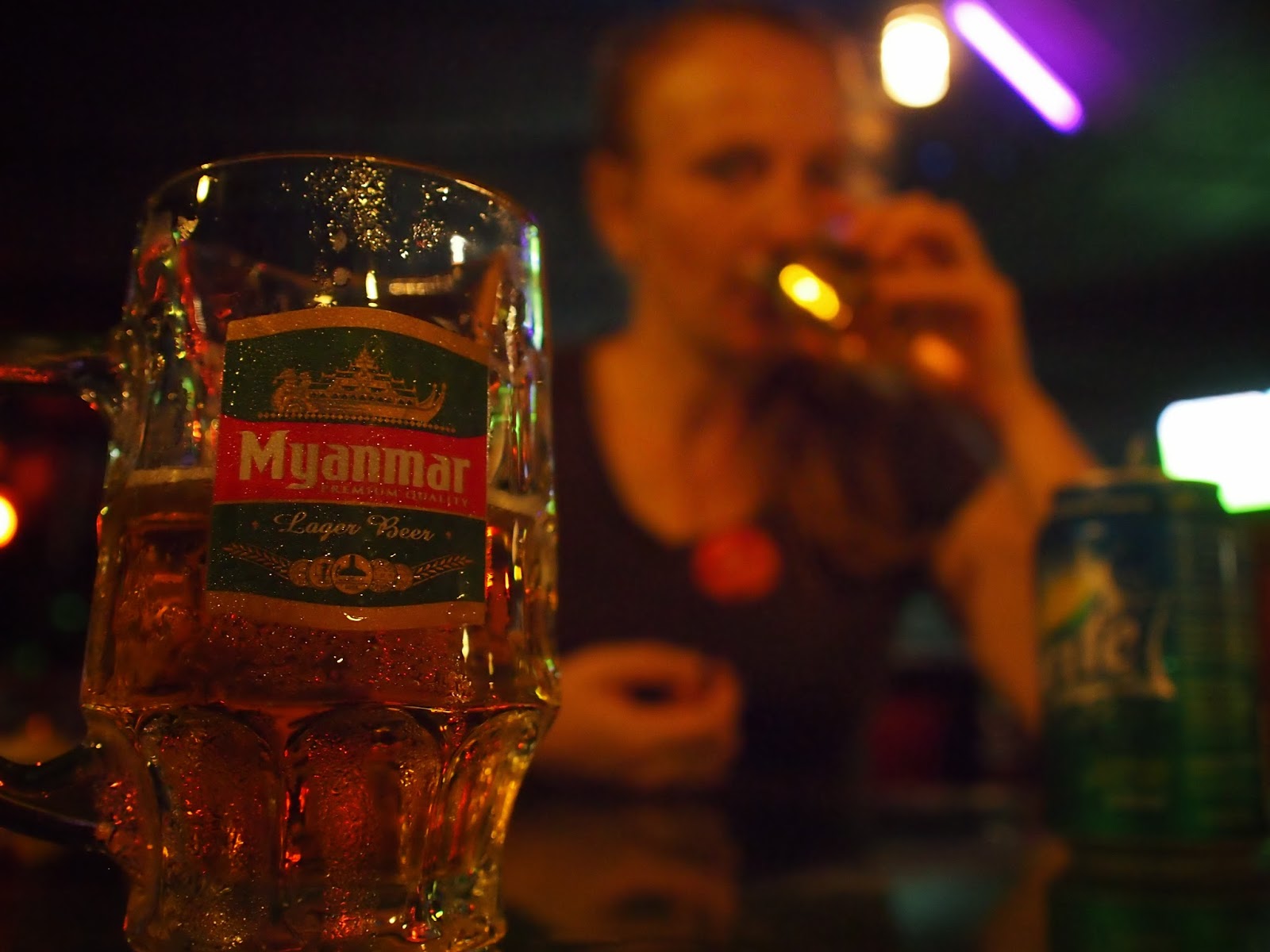
Everything. Have a quick look around the restaurant to ascertain basic hygiene standards, and then tuck in. Mildly spicy, so after two years in Malaysia I had no problems ordering the 'hot' food. Pork option universal. Generally nothing has fish-head in it, it's just fresh, simple flavours. Wash it down with Myanmar Lager: it's probably cheaper (safer?) than water anyway.

I went for a walk around, and found a protest. Workers were upset about their factory being closed, and were taking part in a hunger strike to promote their cause. This was in the centre of town, beside the second largest Pagoda. Before the end of the day, a government official had come down to address their concerns, and the strike had ended.
It's a nice though that the government now responds positively to a cry for help from the people, but I'm not naive enough to think this is the case Myanmar-wide. There's a whole people group that are currently not recognised by the government... because they're muslim, not buddhist. Yeah... not convinced. I was approached by a local journo who gave me the basic run down. Apparently having ten day growth and a backpack on makes you look like a reporter. I must remember that.
"Hello, would you like to come and see the protest?"
"Yeah, what's going on over here?"
"Hunger strike protest. They don't wan't money, they just want jobs... are you, maybe, a reporter?"
"Oh me? No, sorry. I just have a camera..."
"Oh, haha, I thought you were freelance..."
"Well, I'm if you mean 'free' as in 'no-one pays for it', then yeah, I guess I am..."

"Dey took err jerrrrbs" IRL edition


Anywho. We stayed in Yangon, where accommodation is crazy overpriced, (we're talking Melbourne prices for third-world spec rooms... yep, it's a joke) we stayed in Mandalay, where they make awesome velvet thongs, and Bagan, where you will learn to hate Pagodas. It's kinda cool though.
There's thousands of brick temples there. It's as though for a one hundred year period, 50% of the population made temples, and the other 50% made bricks. And it's not all nice stuff either, there's plenty of horrible stories of brutality from the rulers of the time pushing to get them up. Mmm.

 At some stage, 'enlightenment' meant 'sticking neon lights behind Buddha'. I have no explanation as to why I found that so amusing.
 Green dude approves, but it's fair to say he's biased.


This church in Mandalay looked way too much like the preacher robot from Futurama


We were about done in Mandalay when I decided to remodel my toe. Toes and number plates don't mix, so be careful not to kick them in an uncovered state. Ironic that the worst injury I've ever gotten from a bike was getting on the bloody thing.
So after a day or so of bandages, I got sick of not being able to fit my foot into shoes, and walking meant that the wound kept bleeding, so I took Luke Wilko's advice and sent Jem for superglue.
Enter Jem, finding a dinky little hardware shop in Mandalay..
"Can I help you?
"Um, yes... I'm just looking for superglue."
"Ok, what do you need to use it for"
(Jem is slightly taken aback by the perfect english spoken by the female store clerk)
"I need to glue my husbands toe back together."
(without hesitation) "Here, use this one. It's made in China, it's much better quality than that Thai made stuff."
FYI, superglue is less painful than stitches, and so, so much faster than waiting for the wound to seal up. 10/10 would use again. No side effects I'm aware of. The pink elephant that has been following me is apparently from something else.


Umm... mum asked me about my uni studies. I am still technically studying, but if I were to give myself advice three months ago it would be something like this: Don't muck up your credit card so you can't order books until week five and then work on a movie set for two weeks and then try and catch up for one week and then go on holiday for another two, or you may find yourself failing a semester in it's entirety.
Just sayin'.

Mandalay. One of the Pagodas. The one on the hill. That narrows it down, right?
 
Temples, pagodas and... oh hey, it's a lizard... nice.

We bought some paintings from here. They're pretty sweet.

mmmmm.... vomitous
The outside is calm, but the inside threatens violence should he spit red beetlenut slime in front of her just one more time...
Got swagger?


 For those concerned, this man isn't drowning. He's actually fishing. I'm aware that seems unlikely.
 'Do you like stairs? You'll LOVE Myanmar!'
 Saturated dude with large fish indicating previous picture of different person was indeed fishing and not drowning


I talked to this guy on the street. He told me that he realised I was busy just then, but should I ever be back in Yangon, he'd like to invite me to his house. Although he couldn't give me his phone number (he didn't have one) and he couldn't give me his email (he didn't have one) but if I took his photo, and asked around, someone would know where to find him. He's known on the street, you see...
So, yeah. Hopefully some updates will come a little more often now. But, you know me. So let's all just hope together.

Thursday, 28 February 2013

Wanna see a cow race?


Leong's bike ground to a halt, kicking up a cloud of red Cambodian dust. He points to the dried rice fields on his left. My eyes are drawn to a massive crowd of people standing in the middle of the field.
With a smile that seems to cover his whole face, he says words not usually put together:
“Wanna see a cow race?”

On the rare occasion a man is asked whether or not he wants to see a cow race (or, for that matter, a racing cow) there is only one answer he can possibly give.
So we doubled back, and began to cut across the field towards the mass of villagers gathered.
Pulling up next to the cart selling iced sugar cane juice, (which I usually hate, but three days of eating trailbike-thrown dust made it taste incredible) it was immediately clear that whatever the focus of the day had been before we had arrived, it had now changed. We were swamped.
Small children dared each other to approach, pushing one another forward before chickening out and retreating behind the nearest adult. I fished around in my bag for half a packet of jubes and a few packs of peanuts, and eventually managed to give them away by kneeling down, head bowed, before the intended recipient snatched it from my hand and darted back to safety.
We smiled and shook hands with the gathered friendly locals and immediately regretted not knowing any khmer (Cambodia's native language) whatsoever. A much older Khmer man in a weathered camouflage jacket (apparently oblivious to the thirty-something degree heat) approached me humbly, bowing his head as he clasped my hand with both of his, and if his beaming toothless grin was anything to go by gave me the warmest of greetings possible, seemingly honoured to have simply made my acquaintance. Knowing full well Cambodia's history, and (to put it bluntly) the rarity of someone his age, I suddenly felt very small, and then incredibly inadequate of doing this occasion due justice. A man like him would have some stories to tell.
Our guide Leong worked his way through the crowd.
We're on the final leg of a three day trailbike trip through southern Cambodia, and making our way back to Phnom Penh. My oldest friend was getting married, and as best man I thought the buck's party would be better spent in south east Asia than on a pub crawl through Melbourne. So, with him having never left Australia (but for a short trip to England, which absolutely doesn't count) I dragged Neil out into the middle of nowhere to celebrate the closing of the longest chapter of his life. Fortunately, we found a cow race, and the trip was a great success.
Leong calls us over. The locals have directed us as to where the best place to capture the race is. They factored in wind direction, so we wouldn't be covered in dust. I'm fairly sure they didn't understand what we'd been up to in the previous days. They pushed us well back from the track, signalling that they really couldn't be too sure as to where the cows would run though.
The wind changed, and they hurried us to the other side of the field. And then I saw the racers.
Two bulls strapped to a cart. A muscular Khmer atop of the cart, wearing nothing but a loin cloth and sporting some of the finest mutton chops I've seen since the last time I went to the Drysdale RSL. Wielding a stick that is probably best described as a goad, they cut an imposing figure.
The bulls ambled their way to the opposite side of the field where their opponent was waiting, and the anticipation grew.
I was assuming all this time that the bulls would run side by side, drag racing style. I was fairly confused when this didn't happen, and the bulls and carts tore past one after the other, the pair behind almost pushing into the cart in front. They crossed the finish line, the crowd erupted into cheers, and then were promptly chocked out with more red dust.
Neil, Luke (our fellow groomsman) and I looked at each other and shrugged our shoulders. We had just witnessed the craziest race any of us had ever seen, and had no idea who'd won.
Leong came to the rescue.
Should, by chance you have met Leong, you would understand why I haven't tried to quote him directly in what he said. He's got a strong twangy Cambodian accent at the best of times, and when he talks quickly sounds almost exactly like Jar Jar Binks. Except that Jar Jar is slightly more comprehendible, and everyone wants to kill him. Leong, on the other hand, is a top bloke.
Leong explained that when the bulls race they tie a piece of bamboo between the two carts. Should the bamboo fall, the cart in front is declared the winner. Should it stay up, as was the case here, the cart behind is crowned victorious.
The crowd gathered around the cart. I walked past the bookie, dealing out big handfuls of rial. A man walked past me, big grin on his face, fanning himself with a massive wad of cash, like some sort of a Cambodian TAB commercial. I see a kid I've previously given a small packet of peanuts to, following me around like a pup, unopened packet still in his hand. If I was his age, I don't think I would have saved it to take back to the family. I feel pretty small again.
After another 20 minutes of smiles, shaking hands, and shy children, it's time to go.
Whenever we're cutting through a village on the big dirt bikes, kids run out to the front fences to wave, and the younger adults usually give us the universal 'do a wheelie' charade act, waving their arms in the air. Leong obliged, Neil took off with him, and Luke tried to do the same. Immediately Luke was choked out in the dust, and his bike ground to a halt. I was fifty meters away filming, and he couldn't hear what I could hear over the noise of the other bikes.

We're in the middle of nowhere. I can't even see the village from where these people must have travelled from. We've got 100 or so northbound clicks to ride to get to Phnom Penh before dark, through fields, goat tracks, railway lines and through villages. 
There's five hundred or more Cambodian villages in field for a cow race.
And right now, every one of them is laughing at Luke stall his bike in the dust. 


Wednesday, 7 November 2012

The ongoing horror of Svay Pak

'High Street' Svay Pak

I feel sick to my stomach. I steady myself against the wall, and breathe for a moment.
This was on the wall when we got here,” he says, motioning to a sketchy hand drawn princess. Something any little girl would've drawn.
We left these rooms as they are to show people what it was like.” The stalls (the term 'room' is misleading) are tiny, with a simple bed, a curtain for a door, and no roof. No privacy. Nowhere to hide. No escape from the noise. No escape from what they had become.
And upstairs, was the pink room...”

The last few days has been a learning experience.
This time, I knew of the Cambodian history.
I didn't know how it would effect me. I didn't know how it affected the present Cambodia.

Come with me to Svay Pak. Walk down the dusty street, lined with run-down (so, normal) looking shops. See the regular smiling kids walk about the place.
There's nothing to immediately discern the place from any of the other poor areas around Phnom Penh.

We walk into a modest sized hall, with colourful paintings on the walls.
It's a friendly place, kids noisily moving about the room. There's a large colour-filled 'Good Shepherd' painting on the wall.
We're led around, shown the rooms where they hold the kids club, english lessons, pre-school... It's all madly familiar to me. Just like the YWAM centre in Bacolod, Philippines that I spent time in when I was ten.

Across the street is a gym. There's some of the skinniest gym-users I've ever seen pumping iron, and chatting with their mates in their baseball caps and singlets.
We run a kick-boxing program, and a weights and PT program too,” says Isaac.
It's a great way to get the guys interested. Some of them have actually gone on to kick-box professionally.”
He smiles.
To come from a poverty stricken neighbourhood, to now being able to support himself and his family, and keep his sisters out of brothels... “It's a cool story, actually...”

We walk down the street to another hall. 'Rahab's House' is emblazoned across the facade.
This is the original centre,” says Isaac.
The building was rented by Don when they first started up in Svay Pak. It was abandoned at the time, and central to the town. It needed some work, though, because it was last used as a brothel.”

I knew this. I joked to Isaac about the dark irony of the building... and then immediately the gravity of the situation took hold of me.

Shut up, Josh, I thought. There's nothing funny here...

When they moved in they knocked down most of the stalls, as you can see...”
I walk along the wall. I can see the ends of the brickwork, marking out the tiny stalls.
...but we left a few of them here, so that people could see how it was. And we left this...”
The curtain is drawn back, and I see the picture on the wall.

Psychologists will tell you that abused children invent imaginary friends, or even different lives in their mind to escape from extreme abuse.

It's clear that this room was occupied by a child, but in her physical surroundings - her detainment - there are some things she couldn't escape from. She was a slave. With no rights and no future. She was there to please her captors, the wardens and any man who walked through the door.There are some things she couldn't escape from.
I feel physically sick. “Upstairs,” says Isaac, “was the pink room, where you could buy a virgin.”

Just eight years ago, this was a house of pain. Now it's a house of restoration. I'm trying to grasp hold of that, but it's seriously doing my head in.
It was around eight years ago that the initial raids in Svay Pak occurred. The obvious brothels were closed, the owners were arrested, and some of the sex-slaves were released from their effective bonds.
But the unfortunate truth of how things are in Cambodia, is that within a week nearly everyone had been released from prison.

The sex trade returned to Svay Pak, only now it had been pushed underground.
Harder to see, harder to infiltrate, and just as evil as ever.

What we have now, is someone sitting in a cafe, waiting for a pimp to walk past and set up a deal.” says Isaac. “Now some of the major hotels in Phnom Penh will set up the deal for you, and arrange for the child to be brought to your room.”
The paedophillic sex tourism industry in Cambodia is alive and well.

The UN states that 80% of Cambodia's “Sex Workers” are between 12 and 18 years old. The reality of the situation is that the term 'workers' isn't a true description of many of the girls. Being a 'worker' suggests a choice in the matter, some sort of rights, and a basic wage.
What actually happens to many of the girls (and boys) is that they are sold into the industry by their impoverished parents, or lured across the border from Vietnam to nannying or domestic worker positions that don't exist.
Once they've been taken by a pimp or brothel, they are no longer a worker.
They're a slave, plain and simple.
They have no choice in coming and going, no choice on yes or no. They are an object for someone else to exploit.

The facts that come out of Svay Pak are staggering.
Reports of girls as young as six being sold are common. Children are bought and sold, traded across the Thai and Vietnamese border like some sort of commodity. Entire factories are run on slavery. During our tour, Isaac tells me of a woman who has been enslaved in a brick factory for twenty years in an attempt to pay off a $200 debt.

The whole situation is being taken advantage of not just by sex tourists, but by locals as well, and kept open by corrupt government officials turing a blind eye. Of course, soliciting children is illegal in Cambodia, but the arrests are few and far between. Examples of handcuffs 'slipping off' on the way to the courthouse are the rule rather than the exception.

Rahab's House has many stories of 'rescue-raids' being foiled by corrupt police.
The last time it happened, the rescue targets were two enslaved girls; one 12, one 14. The day before the raid two uniformed officers walked into the house and notified the owner of the planned action. The house was raided the next morning, and the girls were nowhere to be found. These stories are commonplace.

When I first found out about Cambodia's history, I read an article in which the author explained the extreme levels of injustice as such:
'The evil of the Khmer Rouge lives on within the people that it was inflicted upon.'
It made sense to me. In a land where all the intellectuals, policy makers, teachers, and anyone of employable intelligence/book knowledge was murdered, there was no-one left to guide those who remained. Think of the pillars of society in your own communities- Mayors, Clerics, counsellors... Anyone seen as a threat to the Khmer Rouge was eliminated. Many of the children were left without parents. A lot of those that survived moved into crime and prostitution out of not just desperation, but because there was literally no other option. The only people in Cambodia with money were soldiers.
You are now faced with the result of an entire generation that was raised without guidance.

Isaac put it quite simply: Many of the people lack a moral compass. As a result, we have parents that would sell their children, and wage-earning government officials that would accept a bribe rather than liberate a child.

But fortunately, the story doesn't stop there.
Because despite the setbacks and constant frustrations, there are people who were outraged enough to put themselves in the middle of all of this and do something about it. Little by little, things in Svay Pak are changing. It's slow, hard work, and work that needs our support.

One of the biggest problems is that people don't know about Svay Pak,” says Isaac.
The pedophiles know. They know it's somewhere they can come and have sex with a little kid.”

I feel physically sick. Again.


To those who know me, I ask as a personal favour to me that you share this story with your friends, work mates, team mates and families.
It's been too long that Svay Pak has been famous to the perpetrators alone.
We can change this.


Joshua Welsh
no1welsh@gmail.com
This interview was arranged by Change Your World, a group set on highlighting the issues of modern day slavey in Asia today.  www.changeyourworld.com.my

For more information on Rahab's House see http://agapewebsite.org/projects/rahabs-house/

Wednesday, 10 October 2012

"It would've been a good school."

I first landed in PP in about March this year. I play football with a bunch of expats in Malaysia, and we'd arranged for a friendly against a bunch of expats in Cambodia. It was only a weekend thing, footy match, then an after match bar, and that was about it. I liked the vibe of the place- the people were friendly enough.

I didn't know anything about the history of the place. I sat up late on the computer researching it the night after I got back. As I was reading, I realised I'd noticed the disturbing lack of old people.
I remember the chills going down my spine.

If you're like me, and don't know what happened here within the last 35 years, then do some research. And then send an angry letter to your world history teacher.

This trip was going to be a little bit different.

I'd looked into visiting the Killing Fields. I wasn't too sure how I felt about it.

Both the Killing Fields and S-21 are now owned by a Japanese mob, and I'm not very sure about where the money goes. I think Cambodians have suffered enough without being robbed as well. I was pretty decided on not visiting either of the places.

I think it was boredom that got us in the end, and we found our way to S-21.

S-21 was a detention/interrogation centre where suspected traitors of the Khmer Rouge were house and inevitably executed. KR were very good at keeping records, so we can ascertain quite clearly that of the 20,000 inmates that entered, only 7 came out alive. All of the prisoners were photographed on entry, measured, weighed. The records are plastered all over the three main buildings that S-21 consists of.

Like many things in Asia, once you've passed the first few things, everything starts to repeat itself, and it gets a bit same-same. You start to gloss over.

I didn't want that. It didn't feel right to view the place without being shocked, traumatised even.

The whole place gave me chills.

S-21 was originally built as a school. The classrooms hastily and fairly crudely converted into some twisted asian version of Guantanamo Bay.

It still looks like a school. Just a non-descript set of white buildings. Creepily, there's still a set of varying height monkey bars in the yard.

Just like Drysdale Primary.

We walked back out the tuk-tuk, past the beggars and landmine victims. The legacy of the past still remains in Phnom Penh. The KR may have left, but the recovery isn't even close to complete.

We sat on the bike in silence and started our way back to the hostel.

"It would've been a good school," said Steve.

Once upon a time.

I began to think of the people who built it. The town planners, the teachers. The parents of the students.
A school is always a community within a community. Imagine how you would feel, the investment that you made into your community being used as a slaughter house?

The reality is that all of those teachers were either displaced or killed. Anyone with an education was seen as a threat to Communism.

Those parents, planners, and teachers lay silent in the graves of the Killing Fields.


It's not something that's easily put to words.